
Marietta Wood Flooring builds and refinishes hardwood stairs in Marietta, GA, serving surrounding cities including Fair Oaks, Holly Springs, Smyrna, Kennesaw and Vinings. For more than 20 years we have pulled carpet off staircases, fitted new hardwood treads and risers, and hand-finished worn steps so they match the floors at the top and bottom.
Stairs are the part of a flooring job that most estimates get wrong. A staircase has little floor area but a great deal of cutting, fitting and hand sanding, so a square-foot price leaves out most of the work. We count every tread, riser, nosing, return and landing, and price the staircase part by part.
Many of the staircases we rebuild are in two-story subdivision homes where the builder installed hardwood on the main floor and carpet on the stairs. Replacing that carpet with wood is one of the most visible changes a house can get, because the staircase often faces the front door.
Converting Carpeted Stairs to Hardwood
What Is Under the Carpet
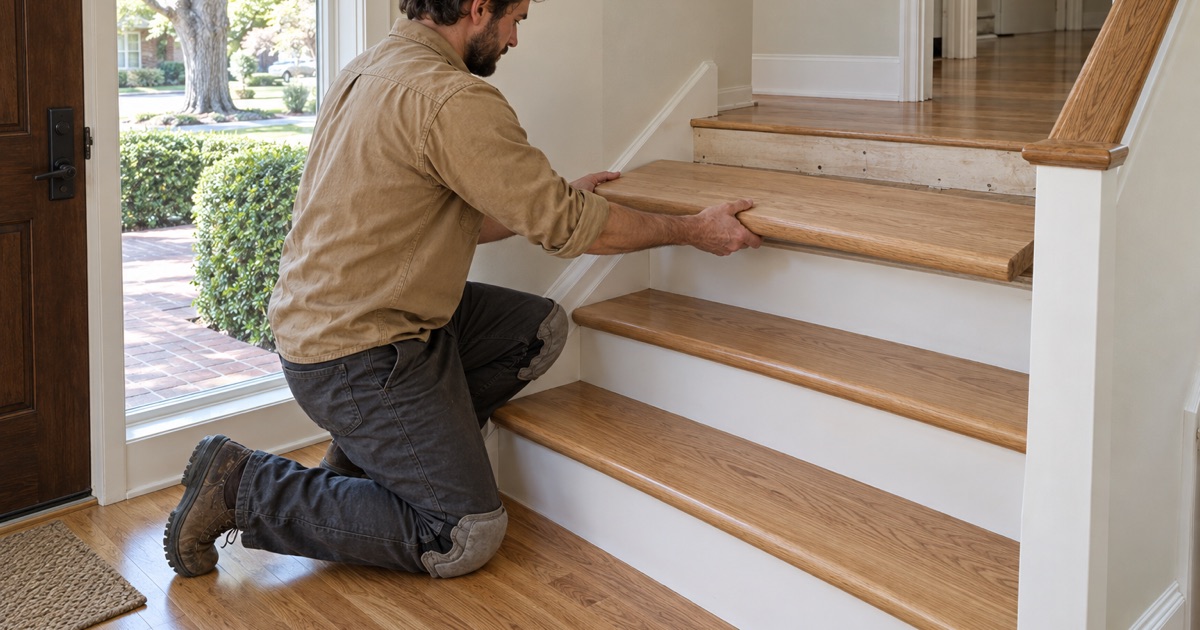
Most carpeted stairs hide rough construction treads made of pine or plywood, never meant to be seen. Once the carpet, pad and tack strip come off, we check those treads for squeaks, uneven heights and damage. That inspection decides whether we cap them with new hardwood or remove them and install full treads.
The carpet also hides old staples, glue and sometimes a nosing that projects too far or not enough for a clean hardwood cap. We price the carpet removal and cleanup as a line on the estimate, so the number does not change after the first step is opened.
New Stair Treads and Risers
New hardwood stair treads come in red oak, white oak, hickory, maple and other species, usually with a built-in rounded nosing. Risers can be wood to match the treads or painted white for contrast, which is a common look in Cobb County homes. We cut each tread to fit its opening, because stair openings are rarely identical from bottom to top.
Treads are glued and fastened to the stringers or rough treads so they stay silent. A tread that squeaks after installation is almost always a fastening shortcut, and it is the one flaw nobody forgets.
Returns, Landings and Winders
Open-sided stairs need mitered returns on the exposed tread ends. Landings need flooring that ties into the treads with a matching nosing, and winder steps at a turn need treads cut to their angled shape. Each of those adds labor, which is why tread-by-tread pricing separates them rather than hiding them in an average.
A curved or split staircase is its own project. Curved treads are often made to order, and the lead time for those pieces sets the schedule, so we measure them early and order before the rest of the work begins.
Refinishing Existing Hardwood Stairs
Hand Sanding Each Tread
A floor sander cannot run on a stair tread. Each tread, riser and nosing is sanded by hand with smaller sanders and scrapers, working around the balusters and into the corners. That hand work is the reason stair refinishing costs more per square foot than a floor, and the reason it deserves its own line on the estimate.
Worn stairs show the most wear on the front of each tread and the nosing, where every step lands. Sanding has to reach bare wood there without rounding over the nosing profile, which takes patience rather than a heavier grit.
Matching the Floor Color
Stairs connect two floors, so their color has to work with both. We test stain samples on the stair treads themselves, since the treads may be a different cut or species from the floor. When the stairs and the main floor are refinished together, the color and sheen match naturally.
When only the stairs are being refinished, we match to the existing floor as closely as possible, and we tell you where age and wear will leave a slight difference.
Finish Durability on Steps
Stairs take concentrated wear in a small area. We use durable finishes, often a waterborne polyurethane with multiple coats, and recommend satin or matte sheen levels that hide scuffs and are less slippery than gloss. Hardwax oil is an option where easy spot repair matters more than maximum durability.
The nosing edge wears first on any finish. We build an extra coat onto the front of each tread where the product allows, because that thin line is where a stair finish usually breaks through years before the rest of the tread.
Railings, Balusters and Details
Iron Baluster Replacement
Swapping wood balusters for iron is a common upgrade alongside new treads. The order matters: balusters come out, treads are installed or refinished, then the new balusters go in, so the holes line up with finished wood rather than being drilled through a completed tread.
Iron balusters come in straight, twisted, basket and knuckle styles, and the pattern is usually repeated every few steps. We lay out the pattern with you before drilling, because once the holes are in the new treads the spacing is fixed.
Handrails and Newel Posts
Handrails and newel posts can be stained to match the new treads or painted. We sand and refinish them along with the stairs so the whole staircase reads as one piece. Loose newel posts are tightened before the finish goes on.
A painted handrail with stained treads is a popular pairing, and so is a dark rail over lighter treads. We sample the rail color alongside the tread stain so both are chosen together rather than one being forced to fit the other.
Stair Nosing at Floor Transitions
Where a hardwood floor meets the top step, a flush stair nosing makes the transition clean and safe. We match the nosing to the floor’s species and thickness, which matters most when a new engineered floor meets an older solid staircase.
The bottom of the stair gets the same care. The first tread and the floor around it are where different materials often meet, and a clean, level joint there is part of what makes the staircase look intentional.
Planning a Stair Project
Stairs and Floors Together
Many owners replace upstairs carpet with hardwood at the same time as the stairs. Doing both together means one stain decision, one finish schedule and a seamless look from the main floor to the bedrooms. We price the stairs and the rooms separately so you can see what each part costs.
The upstairs hallway is often the natural stopping point if the bedrooms keep their carpet for now. We finish that edge with a clean transition so the bedrooms can be converted later without redoing the hallway.
Living With the Work
Stair projects can block the main route between floors. We plan the sequence so the house stays usable, finishing alternate steps where the layout allows, and we tell you ahead of time which days the stairs will be off limits.
For finishes that need a full cure before traffic, we set the schedule around your household. Families with pets or young children often plan a night away during the final coat.
Safety and Household Needs
For households with young children, older adults or dogs, we talk through sheen, texture and stair runners. A runner over hardwood treads keeps the look of wood with the grip of carpet down the middle, and we can leave the treads ready for one.
For basement and terrace-level stairs, we look at moisture as well. Solid treads on a stair down to a damp lower level can move and crack, so the tread species and finish there are chosen with the room below in mind.
- 20+ Years on Wood Floors
- Free Written Estimates
- Moisture Checked Before Sanding