
Marietta Wood Flooring installs herringbone wood floors and wide plank floors in Marietta, GA, serving surrounding cities including Fair Oaks, Holly Springs, Smyrna, Kennesaw and Vinings. With more than 20 years on wood floors, we lay patterns and wide boards the way they demand: from a planned center line, with acclimated wood and fastening chosen for how each board will move.
Herringbone, chevron and wide plank are the floors people notice first in a room. They are also the least forgiving. A pattern that starts off center shows its mistake at every doorway, and wide boards installed without proper acclimation open visible gaps through the first dry winter. The layout and preparation are where these floors succeed or fail.
We plan the pattern around your rooms, not around a stock drawing. We also explain the tradeoffs between solid and engineered construction before you choose.
Herringbone and Chevron Patterns
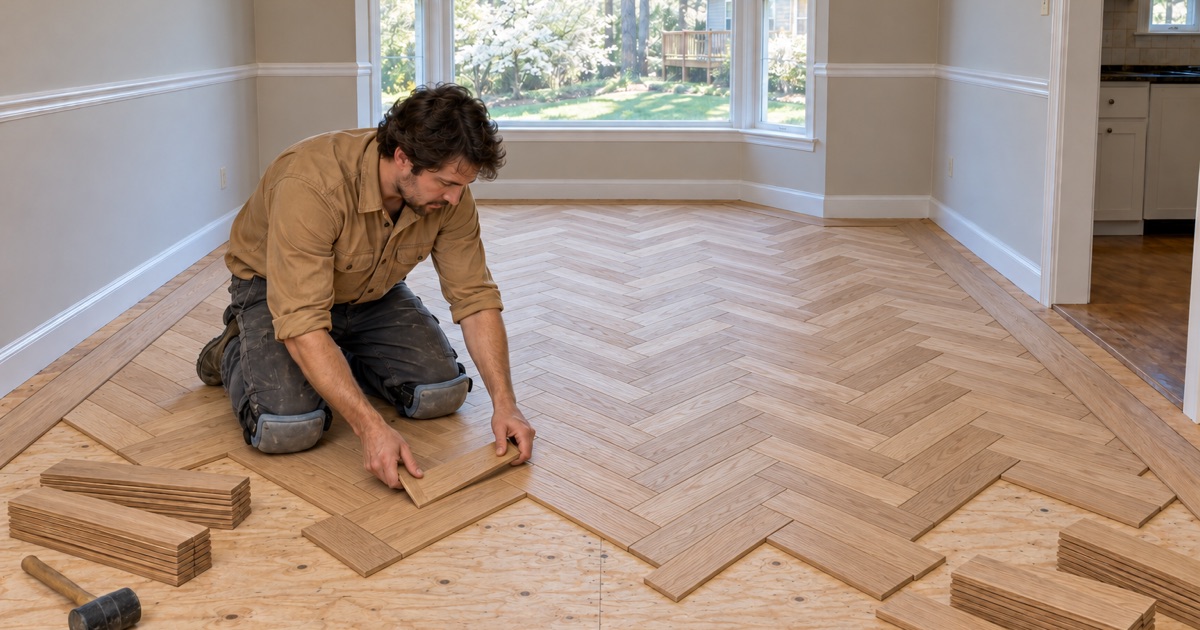
How Herringbone Is Laid
Herringbone uses rectangular pieces set at right angles to each other, forming a staggered zigzag. Pieces come in left and right versions, and each one is placed by hand along a layout line snapped from the center of the room. Because every piece relies on the one before, any error at the start grows across the floor.
We dry-lay the first rows and check them against the room’s walls and doorways before fastening anything. Adjusting a pattern at that stage takes minutes; adjusting it halfway across a room means tearing out work.
How Chevron Differs
Chevron pieces are cut at an angle, often 45 degrees, so their ends meet in a clean point and form a continuous V down the room. Chevron reads more modern and directional than herringbone. The pieces must be precisely factory-cut, and the center line has to be exact, because the points show any drift immediately.
Chevron also has less tolerance for field cutting. Where herringbone pieces can be trimmed at the walls with some flexibility, chevron’s angled ends must stay true across the whole floor, which makes the layout stage even more important.
Planning the Layout
The pattern’s center line is usually aligned with the main view into the room, a fireplace or the longest wall. We plan where the pattern will meet doorways, hallways and cabinets, so the cuts at the edges are balanced rather than leaving a thin sliver on one side.
In open floor plans, we decide where the pattern starts and stops. Running herringbone through several connected rooms is striking but needs careful planning at every opening.
Borders and Transitions
Many herringbone floors are framed with a border of straight boards around the room, which hides small wall irregularities and gives the pattern a finished edge. At transitions to other floors, we use a border or a matching reducer so the pattern ends cleanly.
A border can also be a design feature in its own right, in a contrasting species or with a double row. We sketch the options on your room’s measurements so you can see the proportions before choosing.
Wide Plank Floors
What Makes a Plank Wide
Wide plank floors typically use boards broader than standard strip flooring, showing more of each board’s grain and character. White oak is the most requested species for wide plank, with hickory and other species also common. Fewer seams across the room give a calmer, more open look.
Wide plank also shows character more clearly. Knots, color shifts and grain patterns that disappear in narrow strips become part of the floor’s look, so the grade you choose matters more on a wide board.
Solid or Engineered Wide Plank
Wider solid boards move more with humidity, cupping in humid months and gapping in dry ones. Engineered wide plank, with a cross-laid core, is far more stable, which is why most very wide boards sold today are engineered. We recommend the construction based on the width, the subfloor and the room.
Solid wide plank can still be the right choice over a wood subfloor in a conditioned home, especially where future refinishing matters most. We explain the tradeoff in movement against the number of times each can be sanded.
Acclimation and Fastening
Wide boards need careful acclimation, confirmed with a moisture meter, before installation. Solid wide plank is often glued as well as nailed, and fastener spacing follows the manufacturer and the NWFA Installation Guidelines. That combination keeps the boards flat and the seams tight.
Steady indoor humidity after installation matters as much. Crawlspace homes around Marietta that swing from damp summers to dry heated winters see more seasonal movement, so we look at the crawlspace and talk through humidity control before installing wide solid boards.
Materials and Finishes
Species for Patterns and Planks
White oak is the leading choice for both herringbone and wide plank, taking natural, gray and dark finishes cleanly. Red oak works well where the floor must match existing oak. Hickory adds dramatic color variation, while maple suits a clean, light look. Janka hardness matters in busy homes, and we compare species with that in mind.
Prefinished or Site-Finished
Prefinished herringbone and wide plank arrive with a factory finish and beveled edges. Site-finished floors are sanded flat after installation, giving a smooth surface across every joint and allowing custom stain colors. For patterns, site finishing gives the most seamless look.
The topcoat affects how the pattern reads. A matte or satin waterborne polyurethane keeps white oak pale and lets the pattern show, while an oil-modified finish warms the color and adds depth. Hardwax oil gives a soft, natural surface popular on wide plank.
Sanding a Pattern
Site-finished herringbone and chevron are sanded diagonally and across the pattern, since the grain runs in two directions. We step through the grit sequence carefully and finish with an orbital sander, so no swirl marks show across the changing grain.
Where These Floors Work Best
Entries, Dining and Living Rooms
Herringbone and chevron make the most impact in foyers, dining rooms and living rooms, where the pattern is seen from a doorway. Wide plank suits large open spaces and bedrooms, where the long, calm boards make rooms feel larger.
Below-Grade and Slab Rooms
For terrace levels, basements and slab foundations, we install engineered herringbone and wide plank glued down after ASTM F2170 slab moisture testing. Solid patterns and planks do not belong below grade.
- 20+ Years on Wood Floors
- Free Written Estimates
- Moisture Checked Before Sanding